The short answer
AI automation for a New Zealand small business costs anything from free to $15,000+ in 2026. Off-the-shelf tools run free to about $50 a month. Managed AI plans from NZ providers run about $99 to $999 a month + GST. Custom builds start around $500 for something simple and pass $15,000 for complex systems. Growin charges $3,500 to $5,000 (+ GST) per workflow, fixed price, live in about four weeks.
| Option | What you pay (NZD) | What you get |
|---|---|---|
| Do it yourself with tools | Free to about $50/mo per tool, plus your time | Full control; you build, connect and fix it yourself |
| Monthly AI plan | About $99 to $999/mo + GST | A packaged feature (a chat agent, a reply bot), hosted and maintained |
| AI voice or front-desk agent | About $150 to $999+/mo, plus setup | Answers calls, books appointments, follows up missed calls |
| Custom build | About $500 to $15,000+ | Built for your process; price depends on scope |
| Growin, one sales workflow | $3,500 to $5,000 (+ GST), fixed | One part of your enquiry-to-sale process, built into your tools, with training, documentation and 30 days of monitoring |
Market ranges summarise NZ providers' published prices and Google's NZ answer to this question, checked in September and October 2026. They are a guide, not quotes. All Growin prices exclude GST.
The rest of this article is about a question that matters more than the price: where in your business should that money go? Our answer is the gap between marketing and sales, because that is where most NZ businesses lose the most money for the least effort to fix.
Why the cost question is really a sales and marketing question
Most AI automation pitches start with admin: invoices, rosters, data entry. Those are real jobs, but they save hours. The handoff between marketing and sales is different. It loses sales, and sales are worth more than hours.
Here is how that gap looks in a typical NZ business that spends money on ads.
What marketing sees: clicks, form fills and cost per lead. A campaign can look healthy on those numbers and still not produce a single job, because the reporting stops the moment someone hits submit.
What sales sees: a pile of enquiries, some keen, some tyre-kickers, arriving while the team is busy doing the actual work. The good ones go cold before anyone rings back.
Nobody owns the bit in between. Marketing thinks its job ended at the form. Sales thinks the leads were poor. Both can be right, and the business still pays twice: once for the click, and again for the sale it didn't make.
Speed is the clearest example. A widely cited study in the Harvard Business Review ("The Short Life of Online Sales Leads", 2011) found that firms that contacted an online lead within an hour were nearly seven times more likely to qualify it than firms that waited even one hour longer, and over 60 times more likely than firms that waited 24 hours or more. The study is old, but the behaviour it describes is easy to recognise. Someone fills in your form at 7pm and contacts two other firms while they're at it. Whoever answers first usually gets the job.
That is why we think the first AI dollars in a small business should go to the handoff between marketing and sales, not the back office.
Four sales and marketing workflows, and what each one costs
Each of these is one workflow at Growin: $3,500 to $5,000 (+ GST), fixed, live in about four weeks. Each one closes a specific gap between what marketing produces and what sales needs.
| Workflow | Marketing problem it fixes | Sales problem it fixes | Price (+ GST) |
|---|---|---|---|
| Instant reply and follow-up | Paid enquiries go unanswered for hours | Good leads go cold before anyone calls | $3,500 to $5,000 fixed |
| Qualify and book | Every form fill counts as a "lead", buyer or not | The team spends the same effort on browsers and buyers | $3,500 to $5,000 fixed |
| Instant quoting | Quote requests leak to faster competitors | Pricing lives in a spreadsheet and one person's head | $3,500 to $5,000 fixed |
| Lead-to-sale tracking | Ads are judged on form fills, not sales | Nobody can say which campaign brought the jobs | $3,500 to $5,000 fixed |
Where a workflow lands in the range depends on how many systems it connects to and how many rules it has to follow. A single website form feeding one CRM sits at the lower end. Several enquiry sources, custom pricing logic and a Google Ads connection sit at the upper end. You get the fixed price before we start.
1. Instant reply and follow-up
Every enquiry gets a reply within minutes, day or night, written in your voice. If the person doesn't book, a short follow-up sequence keeps the conversation going by email or SMS. When someone looks ready, your team gets a nudge with everything the customer has said so far.
Alignment win: marketing stops paying for leads that die in an inbox, and sales stops starting every call from zero.
2. Qualify and book
A few quick questions sort the buyers from the browsers: budget, timing, location, the job itself. Serious enquiries pick a time in your calendar, and their answers are waiting in your CRM before the call. The rest get a polite, useful reply and stay in your follow-up.
Alignment win: marketing and sales finally agree what a "qualified lead" is, because the definition is written into the workflow instead of argued about in a meeting.
3. Instant quoting
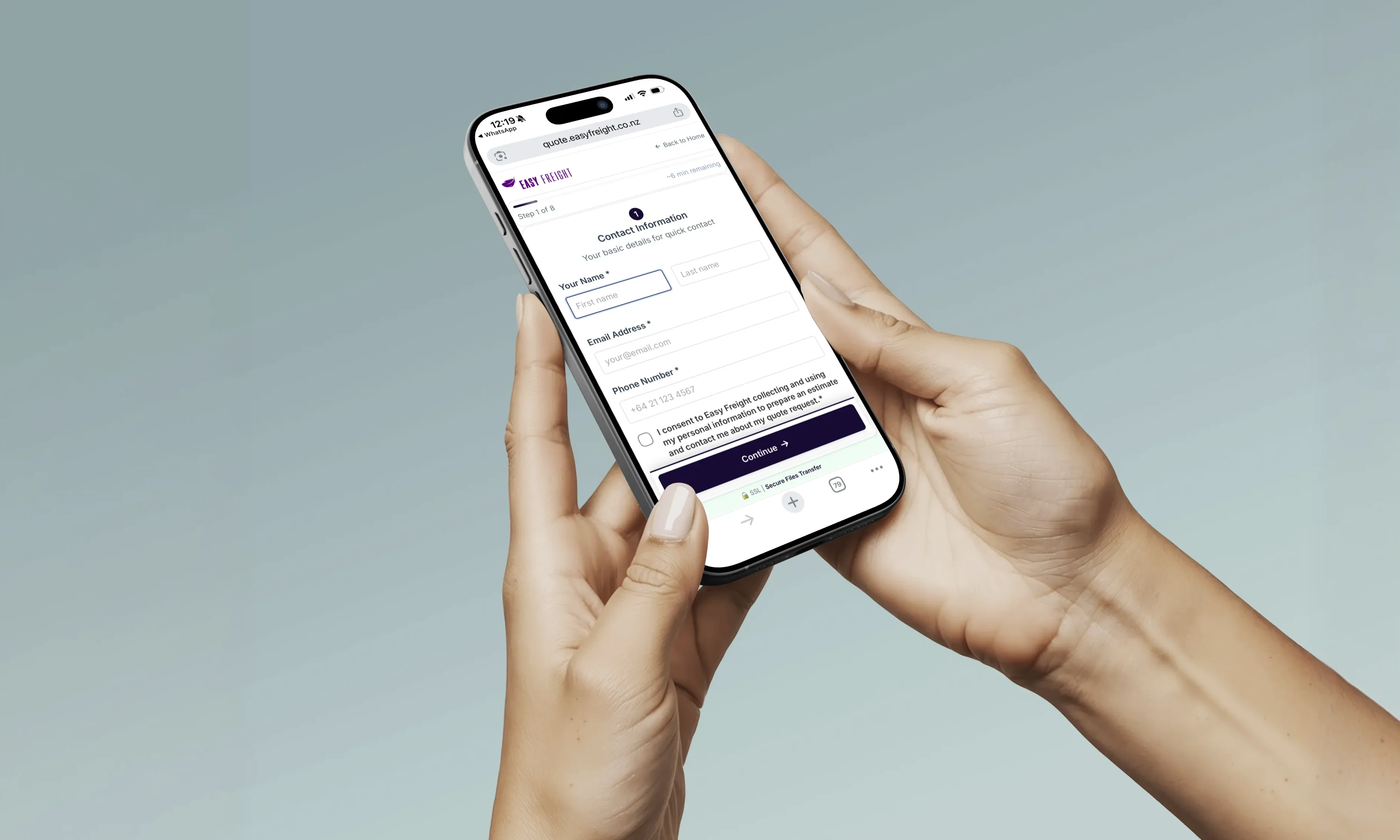
The customer fills in a short guided form, your pricing rules do the maths, and a branded quote lands in their inbox in minutes. This is the workflow with the clearest proof. EasyFreight NZ's quote-and-qualify system took quotes from 2 to 3 days to instant, cut information gathering from 2 to 3 rounds of emails to one, and brought in $13,100 of new-customer revenue in its first 60 days, from 30 new customer jobs. It was a larger, multi-part system with a fixed price of $8,000. The full breakdown is in our case study.
Alignment win: the quote goes out while the customer is still thinking about you, not two days later.
4. Lead-to-sale tracking
Every sale is matched back to the ad and the search that found it, then sent back to Google Ads, so your campaigns learn which leads actually buy. One view shows each lead from the click to the job it turned into, so you see your real cost per sale, not just your cost per lead.
Alignment win: this one closes the loop. Marketing gets judged on revenue, sales gets credit for closing, and the ad budget moves towards the campaigns that bring in customers.
What's included in the price, and what isn't
Included in every Growin workflow:
- A fixed price, agreed before we start. If the scope grows on our side, the price doesn't.
- The build, connected to what you already use: your website forms, CRM, email, calendar and Google Ads.
- Training for your team and documentation you own.
- Thirty days of monitoring after go-live, so we can fix the edge cases.
- What stays human-approved, agreed up front. Anything sent to a client in your name for the first time, such as a quote, gets a person's sign-off until you're happy to let it run.
Not included:
- Your own software subscriptions, such as your CRM or email platform. They stay on your accounts, in your name.
- Ongoing changes after the 30 days. The optional workflow care plan, from $500/mo (+ GST), month-to-month, covers that and scopes the next workflow when you're ready.
- Work outside sales and marketing. If you need AI across finance, HR or operations, that's a different job, and we'll point you to the right people.
Does it pay for itself? Do the maths on sales, not hours
Most AI calculators count hours saved. For a sales workflow, the better question is: how many sales are you losing now, and what is one of them worth?
Here is an illustrative example. These are not a client's figures; swap in your own.
| Your numbers | Example |
|---|---|
| Paid enquiries per month | 40 |
| Enquiries lost to slow or no follow-up | 10% (4 a month) |
| Your normal close rate on enquiries you do follow up | 25% |
| Average value of a sale | $3,000 |
| Sales recovered per month | About 1 (4 × 25%) |
| Revenue recovered per month | About $3,000 |
On those numbers, a $4,500 workflow is covered by about six weeks of recovered revenue. Count margin rather than revenue, say 30%, and it takes about five months. That's before you count the hours your team gets back.
If your numbers are much smaller, for example 5 enquiries a month and a $300 sale, the maths won't work and we'll tell you so. In that case the problem is the number of enquiries, not the handoff, and lead generation is the better first step.
Five questions to ask before you buy
Whoever you hire, these questions separate a sales workflow from a gadget.
- Which number will this move? "Saves time" isn't enough. Ask for the sales metric: reply time, booked calls, quotes sent, close rate.
- Who owns the lead at each step? A good workflow makes the handoff explicit: when the AI hands over, to whom, and with what information.
- Will my ads learn from it? If sales results never reach Google Ads, your campaigns keep optimising for form fills.
- What stays human-approved? You should know exactly what goes out in your name without a person checking it.
- What do I keep if I leave? The workflow, the data and the documentation should be yours.
When AI automation isn't the answer yet
- You don't get enough enquiries. Automation multiplies what you already have. With a handful of enquiries a month, spend on lead generation first.
- Your sales process isn't written down anywhere. If two people on your team would handle the same enquiry differently, agree the process first. A workflow can then follow it every time.
- You want AI everywhere at once. Start with the one leak that costs the most. One working workflow beats five half-built ones.
If you're not sure which leak to fix first, that's what our Free AI Workflow Scan is for: thirty minutes with Igor, then a written report on where your enquiries are slipping between first contact and sale, what each leak is likely costing you a year, and what it would cost to fix. It's yours to keep whether or not you hire us.
FAQ
How much does AI automation cost in New Zealand?
Off-the-shelf tools cost free to about $50 a month. Managed AI plans from NZ providers run about $99 to $999 a month + GST, and custom builds range from about $500 to $15,000+. At Growin, one sales and marketing workflow, such as instant follow-up, qualifying and booking, quoting or lead-to-sale tracking, costs $3,500 to $5,000 (+ GST), fixed price.
How much does an AI agent cost for a small business?
A packaged AI agent, such as a website chat agent or a phone answering agent, usually costs about $99 to $999 a month + GST in NZ, sometimes with a setup fee. A custom agent built into your own CRM and sales process is usually a one-off build. Ours are $3,500 to $5,000 (+ GST) per workflow.
Why focus AI automation on sales and marketing first?
Because that is where it makes money, not just saves time. Most businesses already pay to get enquiries. The fastest return usually comes from making sure more of those enquiries become customers: replying faster, sorting buyers from browsers, quoting sooner and telling the ads which leads actually bought.
Will AI automation replace my sales team?
No. It does the chasing, sorting and admin, so your people spend their time talking to customers who are ready to buy. Anything sent to a client in your name for the first time stays human-approved until you decide otherwise.
How long does it take to set up?
Most workflows are live in about four weeks. That includes building it into your existing tools, training your team and documentation. We then monitor it for 30 days.
Does it work with my CRM and Google Ads?
Yes. We build into what you already use, including HubSpot, Pipedrive, Google Workspace, Xero and Google Ads. Nothing gets ripped out.